
Every hotel has the same arithmetic problem. An online travel agent brings you a guest and takes somewhere between 15 and 25 percent of the reservation for doing it. On a $200 room night that is $30 to $50 gone, on a booking you might have won anyway, from a guest who very often checked your own website before booking.
That last part is the important one. A large share of guests who book through an OTA visit the hotel's own site first. They open it in a second tab specifically to check whether booking direct is cheaper or better. Your website gets its chance. Most hotel websites waste it.
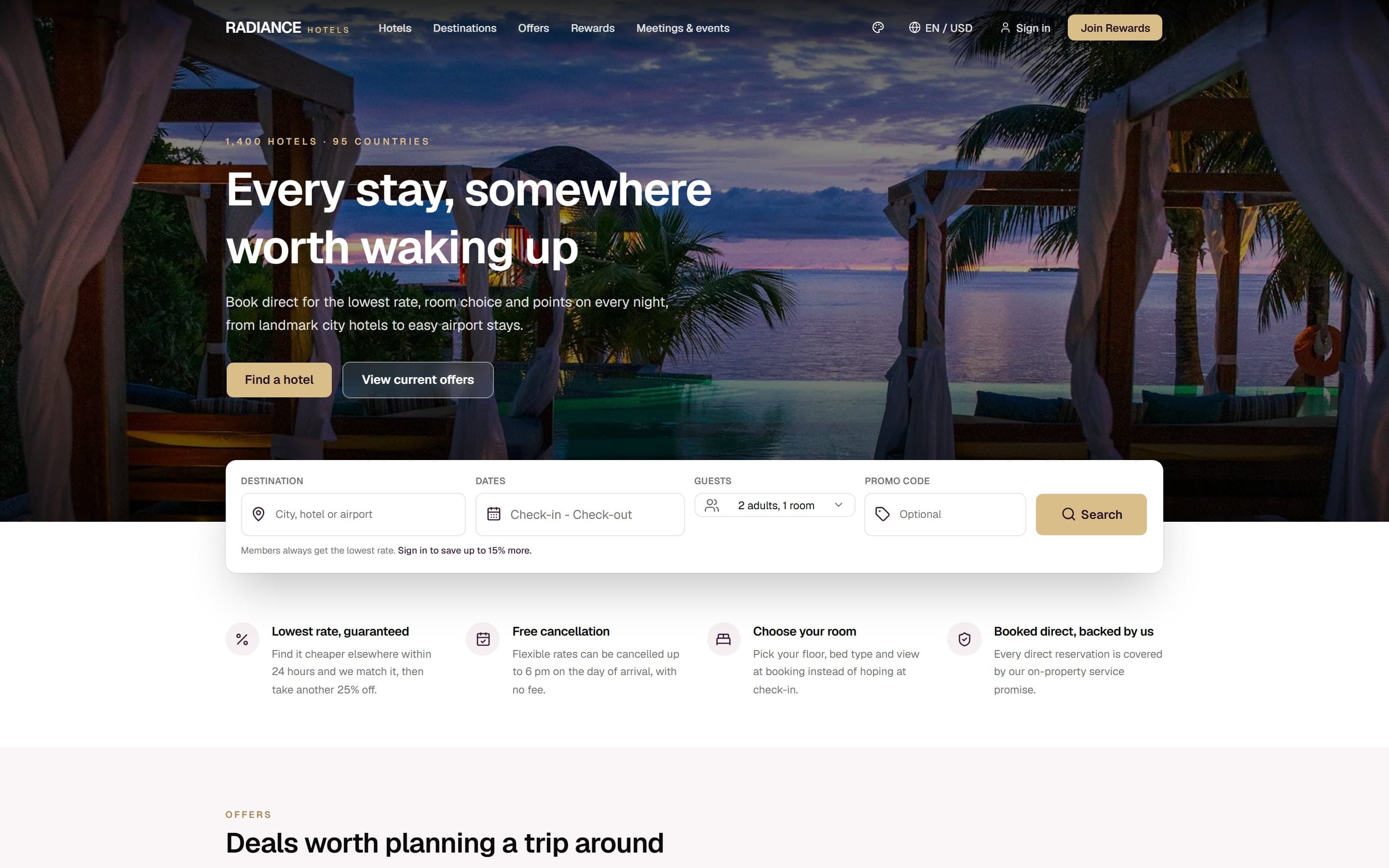
We built Radiance Hotels, a demonstration site for a multi-property group, around this single problem. Here is the reasoning.
You have about ten seconds, and one job
The guest arriving from an OTA is not browsing. They have a destination, dates and a price already in mind. They want to know one thing: is direct better? If your homepage opens with a video of a lobby and a paragraph about your heritage, you have answered nothing, and they go back to the tab that already had a price in it.
The booking widget is not a feature, it is the page
On the demo build, the search card — destination, dates, guests, promo code — overlaps the hero and is fully visible without scrolling. Nothing is above it except the navigation.
This sounds obvious and is routinely got wrong. Common failures we see: the search form sits below the fold on a laptop; it is a button that opens a modal that then loads a booking engine on a different domain with different branding; or it asks for a destination when the visitor is already on a single property's page and there is only one possible answer.
Every extra click between arrival and a date picker is measurable lost revenue. Count the clicks on your own site right now, from landing to seeing a rate. If it is more than two, that is the highest-value fix available to you.
Make the direct-booking argument on the first screen
Guests do not assume direct is better. They assume the OTA has the best price, because the OTA has spent a fortune telling them so. You have to make the case explicitly, and it has to be visible without scrolling.
On the demo there are four guarantees immediately under the search card:
- Lowest rate, guaranteed. Find it cheaper within 24 hours and we match it, then take another 25 percent off.
- Free cancellation up to 6pm on the day of arrival, with no fee.
- Choose your room — floor, bed type and view picked at booking rather than hoped for at check-in.
- Booked direct, backed by us — a service promise that only applies to direct reservations.
Notice that only one of those is about price. The other three are things an OTA structurally cannot offer, and they are often more persuasive, because a guest who has been burned by a bad room assignment cares more about picking their floor than about $8.
Put member pricing inside the booking flow
Most hotel groups treat the loyalty programme as its own section of the website, with its own page, reached from its own navigation item. That is backwards. The loyalty programme is a booking-conversion tool, so it should make its argument at the moment of booking.
On the demo, a single line sits inside the search card: members always get the lowest rate, sign in to save up to 15 percent more. That is a rate advantage, a reason to sign in, and a reason to join, placed exactly where the decision is happening.
Offers that convert have three things
"Special offers" pages are usually where hotel marketing goes to die — a list of evergreen packages with no urgency and no specificity. An offer that actually converts has three components:
- A concrete benefit. "Up to 25 percent off", "breakfast included", not "great value".
- A defined audience. Members, advance purchase, three nights or more, weekends.
- A deadline. Book by a real date.
Every package on the demo carries all three, plus the detail that makes it feel real — late checkout at 2pm, a welcome drink, a full buffet for two. Vague offers are ignored; specific ones get planned around.
Details that matter for an international audience
If you take guests from more than one country — and almost every hotel does — two things are worth building in.
Currency and language switching
The demo has an EN / USD control in the header. A guest booking a London hotel from Sydney should not have to open a currency converter to understand your rate. This is the same reasoning behind the currency switcher on our own pricing page: showing someone a number in a currency they do not think in adds friction at exactly the wrong moment.
Cancellation terms in plain language
OTAs win a lot of bookings purely on perceived flexibility. If your flexible rate genuinely allows cancellation until 6pm on the day of arrival, say so in those words, near the price. Legalese buried in a terms link does not reassure anyone.
What about the booking engine itself?
An honest note here, because it is the question that follows. Most independent hotels use a third-party booking engine — SiteMinder, Cloudbeds, Mews, Little Hotelier and similar — connected to their property management system. We generally do not recommend replacing that. It handles inventory, rates, channel management and payment compliance, and rebuilding it is rarely a good use of money.
What we do is build the site around it properly: search fields on your own page in your own branding, handing off to the engine with the dates already filled in, so the guest experiences one continuous flow rather than being dumped onto a differently-designed subdomain halfway through. That single change is usually worth more than a redesign.
What this costs
A single-property hotel site with a booking-engine integration is typically a Business build for us — from around $750, two to four weeks. A multi-property group site with destination browsing, sub-brands, offers and a loyalty section is an E-commerce and Web Apps build, from $1,800, four to eight weeks.
Against a 15 to 25 percent commission on every reservation, the arithmetic on that is usually not difficult.
See the build
The demonstration site is live: Radiance Hotels. Time how long it takes you to reach a date picker, then do the same on your own site. If yours is slower, tell us about your property and we will send a fixed written quote.
