
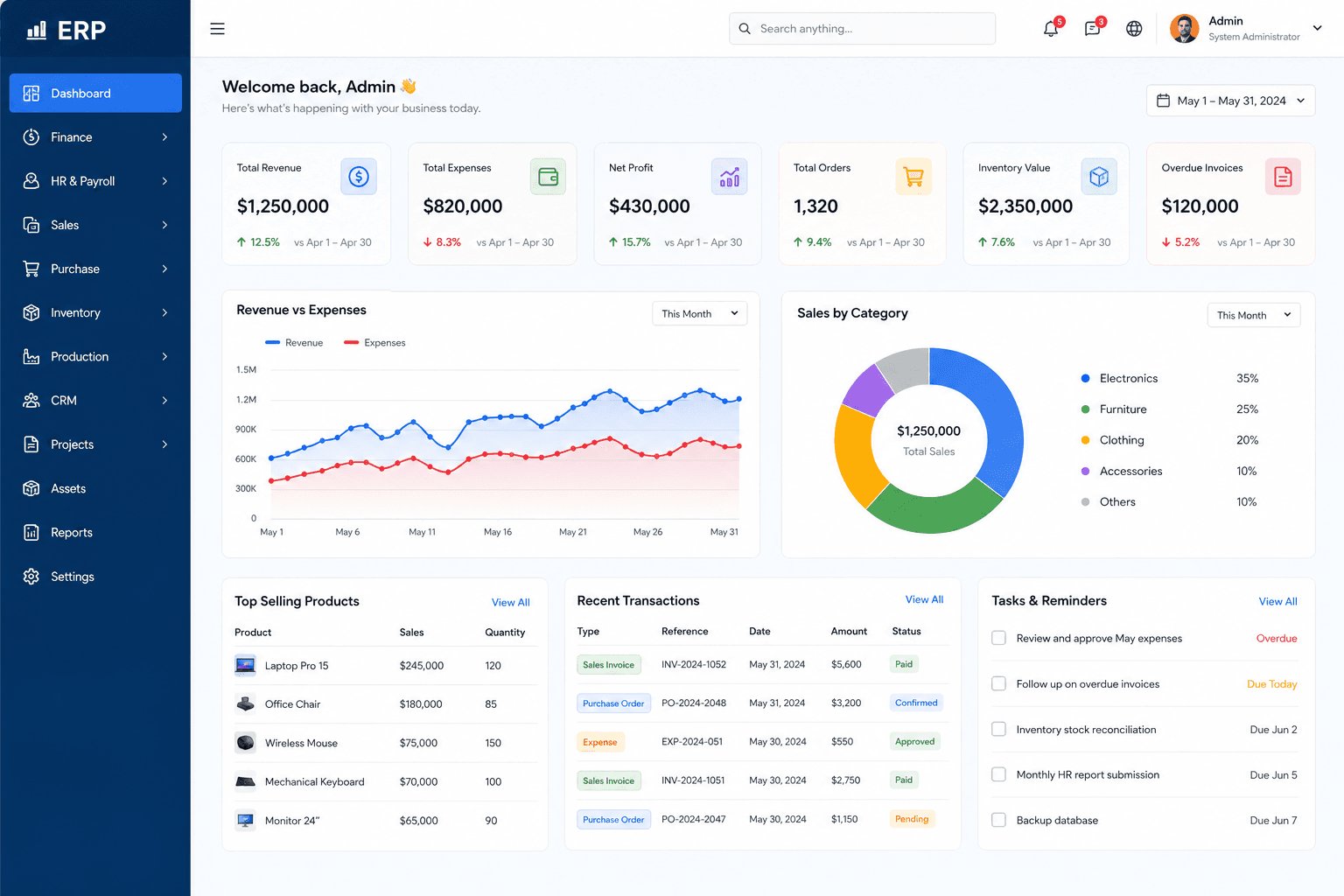
We build custom ERP systems, so it would be convenient to argue that every business needs one. That is not true, and pretending otherwise produces failed projects. Off-the-shelf ERP is the right answer for a large share of businesses. This article is about telling the two cases apart before you commit.
What an ERP actually is
An ERP system connects the parts of your business that currently exchange information through spreadsheets, messages and memory. Inventory, purchasing, production, sales, accounting, and staff records held in one place, so that a stock movement updates the accounts and a sales order reserves inventory without anyone re-entering anything.
The value is not any individual module. It is the elimination of duplicate data entry and the disappearance of the question that consumes so much management time, which is simply: which of these numbers is correct.
When off-the-shelf ERP is the right choice
Choose a ready-made product when most of these are true:
- Your processes are reasonably standard for your industry
- You need to be running in weeks rather than months
- Your budget favours a predictable subscription over upfront investment
- You do not have anyone internally to own a build project
- Statutory compliance, GST and e-invoicing among them, is a major driver, and you want the vendor to handle regulatory updates
That last point is genuinely significant in India. Compliance requirements change, and having a vendor maintain that for you is worth real money. Do not discount it.
Honest assessment: for a business under roughly fifty people running conventional operations, a good off-the-shelf product usually wins on cost, speed and risk. Adapting your process to the software is often cheaper than adapting software to your process, provided the process is not itself a competitive advantage.
When custom becomes the better answer
Custom development starts to justify itself when one or more of these apply:
Your process is the thing you are good at
If how you schedule production, price a job, or route deliveries is genuinely different from your competitors and is part of why customers choose you, then forcing it into a generic product means giving up your advantage in exchange for a licence fee. This is the strongest argument for custom, and the least common.
You are paying for a great deal you do not use
Per-user licensing for a large suite where your team touches a fraction of the modules is a recurring, growing cost. As headcount rises, a one-time build starts to compare well. Work out the five-year total, not the first-year price.
Customisation has already gone too far
Many businesses end up with an off-the-shelf ERP so heavily modified that upgrades break, the original vendor cannot support it, and nobody remembers why half the changes exist. At that point you have the cost of custom without the benefits. This is a common and expensive place to arrive at accidentally.
Integration is the real requirement
If the system must talk to specific machinery, a logistics partner's API, a legacy database, or industry-specific hardware, generic connectors frequently do not stretch far enough. Integration constraints push more projects toward custom than any feature requirement does.
You are running the business through spreadsheets
Spreadsheets that multiple people edit are a well-known source of silent, expensive errors. There is no audit trail, no validation, and no single truth. A business past a certain size operating this way has a real problem, though whether the fix is custom or off-the-shelf still depends on the points above.
A comparison, without the sales pitch
| Consideration | Off-the-shelf | Custom build |
|---|---|---|
| Time to live | Weeks | Months |
| Upfront cost | Low | Substantial |
| Ongoing cost | Per-user, grows with headcount | Hosting and maintenance |
| Process fit | You adapt to the software | Software adapts to you |
| Compliance updates | Vendor's responsibility | Yours to maintain |
| Project risk | Low, proven product | Real, depends on execution |
| Ownership | You licence it | You own it |
Note the risk row. A custom build can fail. An off-the-shelf purchase mostly cannot fail in the same way; it can only fit poorly. That asymmetry should influence the decision more than it usually does.
The hybrid approach
The option most businesses overlook is not choosing at all. Run a standard product for accounting and compliance, where the requirements are common and the regulatory burden is high, and build custom software only for the operational process that is actually specific to you, connected by an API.
You get vendor-maintained compliance, a smaller and cheaper build, and a clean boundary. For a good number of mid-sized businesses this is the correct answer, and it rarely gets proposed because it is not what either type of vendor is selling.
What determines success, whichever you choose
ERP projects fail for consistent, well-documented reasons, and almost none of them are technical.
- No internal owner. Someone senior must own the outcome and have authority to settle process disputes. Without this, the project drifts.
- Unclear scope. Scope that expands continuously is the most common cause of overrun. Agree phase one, ship it, then decide phase two with real usage data.
- Underestimating data migration. Moving years of records into a new system, cleaning duplicates and fixing inconsistencies, routinely takes longer than expected. Plan for it explicitly.
- Treating training as an afterthought. The system is only worth what your team can use. Budget properly for training and for the productivity dip that follows go-live.
- Automating a broken process. If the process is wrong, encoding it in software makes it permanent and harder to change. Fix it first.
How to decide
Answer three questions honestly.
- Is our process genuinely distinctive, or just familiar? Habit is not competitive advantage. Be strict about the distinction.
- What does five years cost, both ways? Include licences, growth in headcount, customisation, maintenance and internal time. Compare the totals, not the first invoices.
- Do we have someone to own this? If nobody internally can commit real time to it, choose the option that requires less of it. That is off-the-shelf.
If the answers point to off-the-shelf, buy off-the-shelf. It is the right decision more often than vendors like us admit, and a well-chosen product that ships in six weeks beats a custom system that arrives late and half-adopted.
If they point to custom, the reason will be specific and you will be able to state it in one sentence. If you cannot state it in one sentence, you are not ready to commit the budget.
