
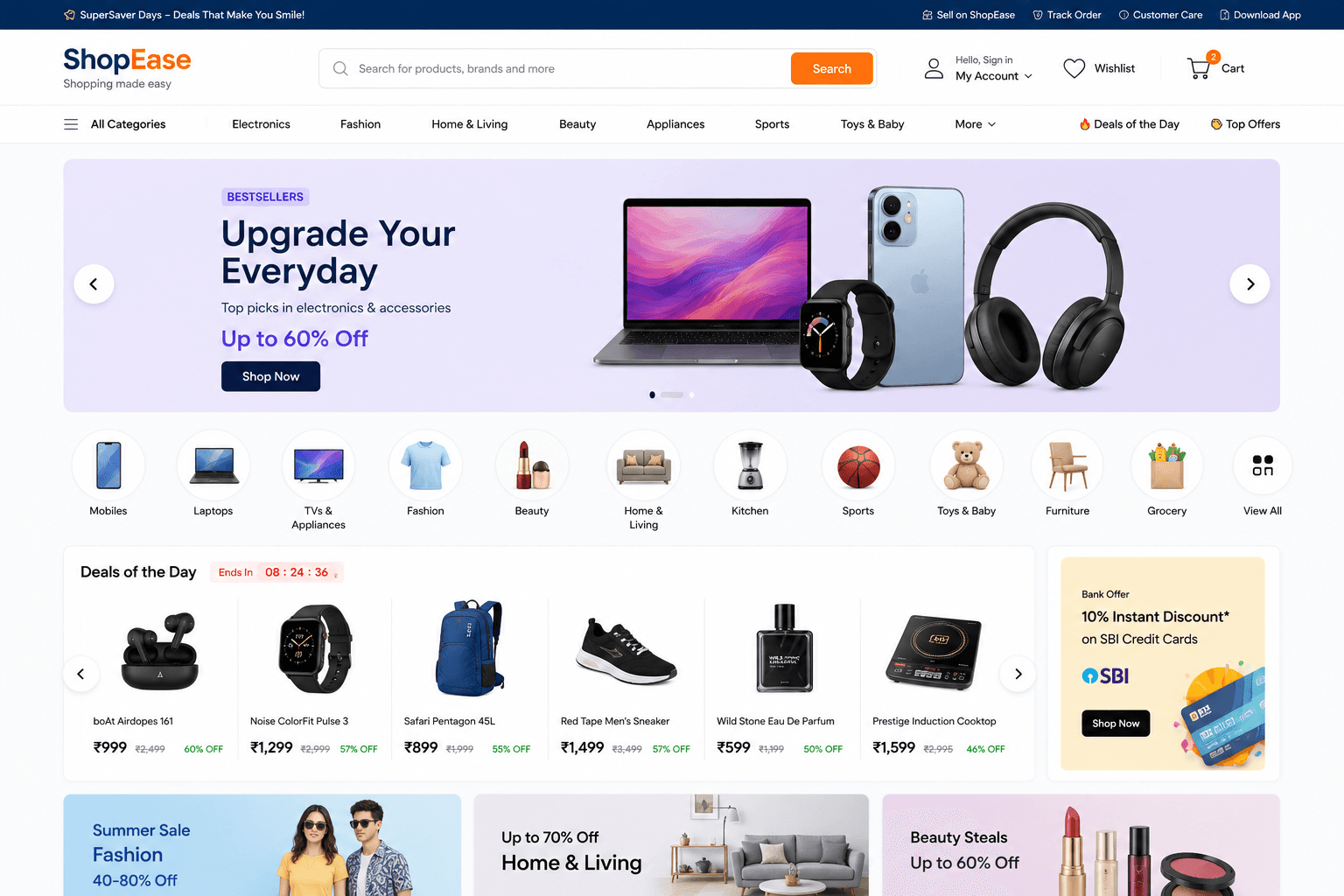
Most e-commerce apps are not uninstalled because they lack features. They are uninstalled because something basic was slow, confusing, or untrustworthy at the exact moment the customer was ready to pay. The features below are ordered roughly by how much damage their absence does.
This is written for the Indian market specifically, where payment habits, network conditions, and delivery expectations differ enough from Western markets that copying a foreign app's design will cost you conversions.
1. Search that tolerates how people actually type
Search is the highest-intent action in your app. Someone using it has already decided to buy something. If it returns nothing, you have lost a sale you had already won.
The requirement is tolerance. Handle spelling mistakes, partial words, British and American spellings of the same word, brand names written several ways, and category words used loosely. Add filters and sorting that respond instantly. Show suggestions as the user types.
Track every search that returns zero results. That list is the most valuable product feedback you will get, because it is a direct record of demand you failed to meet.
2. Payments that match how your market pays
Offering only card payments will cost you a share of your orders, and which share depends entirely on where your customers are. Cards and digital wallets — Apple Pay and Google Pay — are the baseline everywhere. Beyond that the picture diverges: buy-now-pay-later is mainstream in Australia and the UK, direct bank debit still matters across parts of Europe, and PayPal carries far more weight with some audiences than others.
Two rules survive every market. Support the wallets already sitting on the phone, because a checkout that fills itself in converts better than one that asks for a card number. And offer at most one instalment option, chosen deliberately: each additional payment method adds a settlement process, a refund path and a reconciliation job, and a checkout offering nine ways to pay reads as indecision rather than choice.
Whatever you support, the failure path matters as much as the success path. Payment failures are common on mobile networks. If a payment fails, the cart must survive, the customer must be told clearly what happened, and retrying must take one tap.
3. Guest checkout
Forcing account creation before purchase is one of the most reliable ways to lose first-time buyers. Let people buy with a phone number and an address, then offer to save the details after the order is placed, when the customer already has a reason to say yes.
4. Order tracking that answers the question before it is asked
After purchase, customers have exactly one question, repeatedly. Where is my order. Every time they cannot answer it in the app, they contact your support team instead, and that is a direct cost.
Good tracking shows a clear status timeline, a realistic delivery window, live location for the final leg where your logistics partner supports it, and proactive notifications at each change. Getting this right reduces support volume more than any other single feature.
5. Returns and refunds that do not require a phone call
Return policy is a purchase decision factor, not a post-purchase detail. Customers check it before buying, particularly for clothing and electronics.
Make the policy visible on the product page in plain language. Let customers start a return in the app, choose a reason, schedule a pickup, and track the refund status. Refund speed is heavily remembered and heavily talked about. A smooth return frequently produces a repeat customer, which is counterintuitive but consistent.
6. Product pages built to answer objections
The product page is where the decision happens. It needs multiple high-quality images with zoom, a short video where the product benefits from it, complete specifications, honest stock status, the delivery date for the customer's own pincode, and the return terms.
Reviews matter more than any copy you write, and a small number of critical reviews increases trust rather than reducing it. An all-positive review section reads as fake. Size guides are essential for apparel and are the cheapest way to cut return rates.
7. Performance on a slow connection and a cheap phone
This is not a feature, but it decides whether the other features get used. A large share of your users are on mid-range Android devices and inconsistent mobile data.
- Compress and correctly size every image, and serve modern formats
- Load list content progressively rather than all at once
- Cache aggressively so repeat screens open instantly
- Keep the install size down, because it affects install rates directly
- Let users browse cached content when the connection drops, and queue actions until it returns
Test on an actual budget device on a throttled connection, not on a flagship phone on office wifi. The difference is dramatic and it is where most teams deceive themselves.
8. Notifications that are worth receiving
Push notifications are the most abused feature in mobile commerce. Every irrelevant notification increases the chance the app is muted or removed, and once muted you have lost the channel permanently.
Send notifications tied to something the user did. Order shipped. Out for delivery. Price dropped on a saved item. Back in stock for something they wanted. Cart reminder, once, not four times. Ask permission at a moment when the value is obvious, such as immediately after an order is placed, rather than on first launch.
9. Recommendations grounded in real behaviour
Useful recommendations increase order value. Generic ones waste screen space that a better product photo could have used.
Start simple and honest. Frequently bought together, based on your actual order data. Similar items in the same category and price band. Recently viewed. These require no sophisticated modelling and work well. Move to personalised recommendations only once you have enough behavioural data for them to beat the simple version, and measure that they do.
10. Accounts, addresses and a wishlist
Saved addresses with a proper pincode check, saved payment preferences, order history with easy reordering, and a wishlist that persists across devices. These are unglamorous and they are what make a second purchase faster than the first, which is the entire economics of a retail app.
A wishlist is also a demand signal. Items saved but not bought tell you where your pricing or delivery promise is losing you the sale.
What to build first
If you are starting from nothing, do not build all ten at once. In order: a fast catalogue with working search, a checkout that takes cards and the phone wallets, guest checkout, order tracking, and returns. That is a complete, credible shopping experience. Recommendations, wishlists and personalisation are refinements that matter once people are already buying.
The apps that succeed are rarely the ones with the longest feature list. They are the ones where the path from opening the app to completing a payment is short, fast, and never leaves the customer uncertain about what happens next.
